
SoFi Stadium and AT&T Stadium: Are America’s Mega-Venues Ready for Football?
 Available in US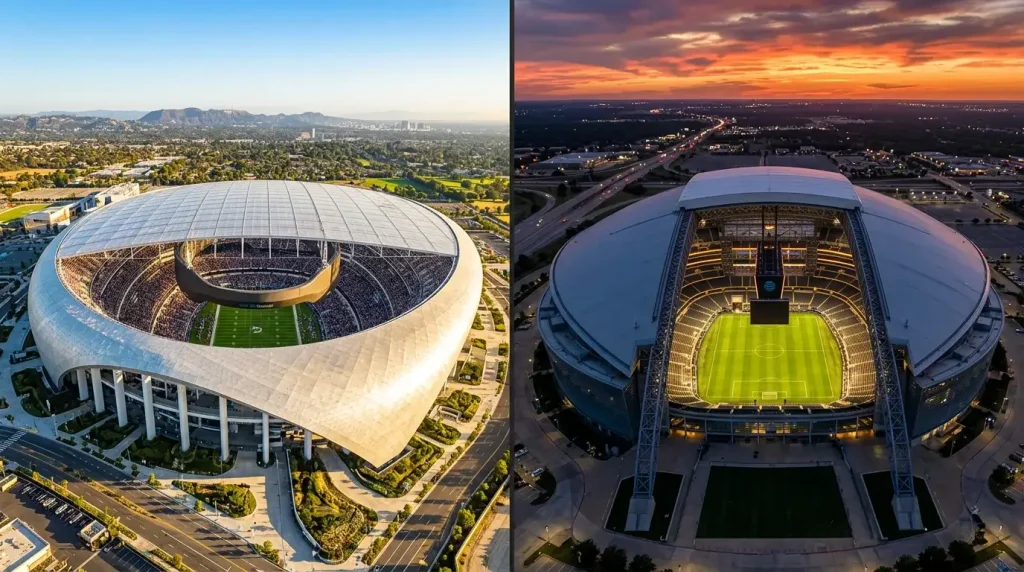
Table of Contents
The United States builds stadiums the way it builds everything else — bigger, more expensive, and with a confidence that borders on audacity. SoFi Stadium in Inglewood, California, cost US$5.5 billion and features a translucent canopy roof that makes it look like a spacecraft landed in suburban Los Angeles. AT&T Stadium in Arlington, Texas, seats over 80,000 under a retractable roof and houses a video board so large it was once struck by a punted football during an NFL game. Both venues host World Cup 2026 matches, and both raise the same fundamental question: can stadiums designed for American football deliver the atmosphere that the world’s game demands?
SoFi Stadium: Los Angeles Gets the Showpiece It Wanted
A few years back, I attended a Copa America match at an American NFL stadium and left with mixed feelings. The sightlines were off — the front rows sat too far from the pitch, and the upper tiers felt disconnected from the action. SoFi Stadium, I am told by colleagues who have covered events there, addresses some of these concerns through its design, though not all of them.
SoFi opened in 2020 as the home of the Los Angeles Rams and Los Angeles Chargers. Its capacity for World Cup configuration is approximately 70,000 to 78,000, depending on the specific pitch layout and broadcast requirements. The stadium’s defining architectural feature is its semi-transparent ETFE canopy — not a fully enclosed roof but a weather-protective covering that allows natural light to filter onto the playing surface while shielding spectators from rain and direct sun. The canopy does not seal the stadium, meaning that air circulation and temperature are partially influenced by external conditions.
Los Angeles in June and July presents specific climate considerations. Average highs range from 24 to 28 degrees Celsius, with low humidity and consistent sunshine. These are among the most pleasant playing conditions at any World Cup venue, and the canopy’s sun-shielding properties prevent the direct solar exposure that causes heat-related fatigue in open-air venues. For teams playing evening matches at SoFi, the conditions will be close to ideal — mild temperatures, no wind, and a surface that benefits from Los Angeles’s dry climate.
The stadium’s location in Inglewood, south of downtown Los Angeles, places it in one of America’s most complex transport environments. Los Angeles’s car-dependent infrastructure means that most match attendees will drive or use ride-share services, and post-match traffic congestion around SoFi is notorious among regular event-goers. The K Line metro extension connects to the stadium area, but the capacity of public transit in Los Angeles remains limited compared to cities like New York or Chicago. Travelling supporters should budget 60 to 90 minutes for post-match departure, regardless of transport method.
From a match-quality perspective, SoFi’s temporary natural grass surface will be installed over the stadium’s permanent artificial turf. The controlled climate — minimal rain, consistent temperatures, professional maintenance staff — should produce a playing surface of higher quality than venues in more variable weather environments. Copa America 2024 included matches at SoFi, and the pitch quality was among the best of any NFL venue used during that tournament, though it still fell short of dedicated football stadiums with permanent natural grass.
The atmosphere at SoFi for football events has been described as impressive but diffuse. The stadium’s expansive concourse and wide seating bowl create a visual spectacle — the Infinity Screen, a 6,500-square-metre video display that wraps around the interior, is genuinely awe-inspiring — but the acoustic properties favour visual entertainment over concentrated crowd noise. European football stadiums generate intensity through proximity and enclosure; SoFi generates spectacle through technology and scale. They are different experiences, and which one you prefer depends on what you value in a match-day atmosphere.
AT&T Stadium: Texas Does Football Its Own Way
AT&T Stadium in Arlington, Texas, is the venue that most directly embodies the clash between American sports culture and world football. Built in 2009 at a cost of US$1.3 billion for the Dallas Cowboys, it seats approximately 80,000 in its standard configuration and can expand beyond 100,000 for special events. The retractable roof — one of the largest in the world, covering roughly 12 hectares when closed — transforms the stadium from an open-air venue to a fully enclosed arena, creating climate-controlled conditions that eliminate the Texas heat that would otherwise make summer football brutally uncomfortable.
And the heat is the key variable. Arlington in June and July regularly exceeds 35 degrees Celsius with significant humidity, creating conditions that would be dangerous for players in an open-air stadium. AT&T’s retractable roof is not a luxury — it is a necessity. When closed, the air conditioning system maintains interior temperatures around 22 degrees Celsius, producing playing conditions that feel more like an indoor arena than a summer match in Texas. For World Cup fixtures, the roof will almost certainly remain closed, which means every match at AT&T Stadium will be played in artificially comfortable conditions regardless of the external weather.
The stadium’s most famous feature — the centre-hung video board, measuring approximately 49 metres wide and 22 metres tall — creates a visual experience that overwhelms first-time visitors. During NFL games, the board is a focal point of the entertainment experience. During football matches, it has occasionally drawn criticism for distracting from the on-pitch action, though FIFA’s broadcast regulations restrict when and how stadium screens can display content during competitive fixtures.
AT&T Stadium’s sightlines for football are adequate but not optimal. The first several rows of seating sit below pitch level, and the pitch itself is configured to fit within the American football dimensions, meaning the touchlines are closer to the front-row seats than they would be in a purpose-built football venue. Upper-tier seats in the end zones are further from the action than equivalent positions in a traditional football ground, and the sheer scale of the interior — the open floor area under the closed roof is among the largest of any indoor space in the world — can create a sense of distance between the crowd and the pitch that smaller, steeper venues avoid.
Arlington itself is a suburban city located between Dallas and Fort Worth, approximately 30 minutes from each by car. Unlike Vancouver or Seattle, there is no rail transit connection to AT&T Stadium — visitors rely entirely on driving, ride-share or shuttle buses. This is a deliberate design choice that reflects the car-centric culture of the Dallas-Fort Worth metroplex, but it creates logistical challenges for international visitors who are accustomed to public transport access at major sporting venues. Pre-match and post-match traffic congestion is a predictable feature of events at AT&T Stadium.
The NFL-to-Football Conversion Debate
Every time an American NFL stadium hosts international football, the same debate resurfaces. Can a venue built for a sport played on a 100-yard field, with different sightlines, different atmosphere dynamics and different cultural expectations, successfully host a sport that demands a wider pitch, closer crowds and concentrated noise?
The honest answer is that NFL stadiums are compromises. They work — the 1994 World Cup proved that American football venues can host successful tournaments — but they do not deliver the same experience as Anfield, the Maracanã or the Westfalenstadion. The pitch fits, the crowds fill the seats, the broadcast infrastructure is world-class, and the hospitality facilities exceed what most traditional football venues can offer. What is missing is the intangible quality of a ground that was built for the sport being played on it — the architectural intimacy that makes 40,000 fans at a dedicated football stadium louder than 70,000 at a multi-purpose arena.
SoFi and AT&T represent the two poles of the compromise. SoFi offers a modern, architecturally ambitious venue with climate advantages and a visual spectacle that will photograph beautifully for FIFA’s broadcast partners. AT&T offers scale, climate control and the uniquely Texan version of American sports excess that creates its own kind of memorable experience. Neither venue will produce the compact, intense atmosphere of a European club ground — but then, the World Cup has never required that. The tournament’s atmosphere is generated by the diversity of the global crowd, not the architecture of the stadium, and both venues will be packed with supporters from multiple nations creating their own version of match-day energy.
Scheduled Matches and What They Mean for Punters
Both SoFi and AT&T Stadium will host group-stage matches, with knockout-round fixtures allocated based on FIFA’s venue distribution plan. The specific match assignments depend on the group draw’s geographic allocation — teams assigned to the southern and western venue clusters will play at these stadiums — and the commercial appeal of each fixture.
For punters, venue-specific factors at SoFi and AT&T create identifiable edges in certain markets. The controlled climate at AT&T Stadium — consistent temperature, no wind, no rain — removes environmental variables that typically affect over/under markets and reduces the likelihood of weather-influenced disruptions. Matches at AT&T should, in theory, produce outcomes more closely aligned with pre-match form than matches at open-air venues where conditions can shift during the 90 minutes.
SoFi’s semi-open design means that late afternoon kick-offs will involve changing light conditions as the sun moves across the canopy — a minor factor, but one that has affected goalkeeping performance at the venue during previous evening events. The “sun factor” at SoFi is a known variable among MLS bettors who follow the LA Galaxy and LAFC, and it could create marginal edges in specific match situations.
The larger point for Australian punters is that venue dynamics at the 2026 World Cup are more varied than at any previous tournament. The 16 stadiums across three countries span climate zones from tropical (Miami, Houston) to temperate (Seattle, Vancouver) to arid (Los Angeles, Dallas under a closed roof). Teams that adapt to venue-specific conditions — training at altitude for Mexico City fixtures, acclimatising to humidity for Houston or Miami matches — will hold marginal advantages over opponents who treat every venue identically. Sharp punters who track squad travel schedules and training locations can identify these edges before the market adjusts.
The Question These Stadiums Answer About American Football Culture
SoFi Stadium and AT&T Stadium exist because the United States builds sporting infrastructure at a scale that few countries can match. They are monuments to commercial ambition, engineering capability and the American belief that bigger is better. Whether they are “ready for football” depends on what you ask them to deliver.
If you ask for comfort, technology, climate control and commercial infrastructure, these venues exceed almost every traditional football ground on the planet. If you ask for intimacy, acoustic intensity and the feeling that the crowd is the twelfth player on the pitch, they fall short. The 2026 World Cup will test both sides of that equation, and the answer will depend less on the stadiums themselves than on the matches played inside them. A World Cup classic at SoFi — a last-minute winner, a penalty drama, a stunning upset — would silence every critic who argues that NFL venues are wrong for football. A series of flat, atmosphere-free group matches would confirm the sceptics’ worst fears.
For Australian punters watching from the other side of the Pacific, the stadium debate is largely academic. What matters is the football, the odds and the alarm clock. SoFi and AT&T will deliver on all three.
