
Should You Trust World Cup 2026 Odds — or Ignore Them Entirely?
 Available in US
Table of Contents
Bookmakers set odds to make money, not to predict the future. That distinction sounds obvious, but I watch punters forget it every four years when the World Cup rolls around and suddenly everyone is treating decimal prices as if they were divine forecasts handed down from a mountain. They are not. They are commercial products — carefully engineered instruments designed to balance the bookmaker’s risk, attract wagering volume, and generate a margin that keeps the lights on. Understanding how that process works, where it breaks down, and when the resulting World Cup 2026 odds genuinely reflect probability versus when they reflect crowd sentiment is the difference between punting with an edge and punting with hope.
I have spent nine years pulling apart odds for international tournaments, comparing pre-tournament prices against actual outcomes, and building a database that tracks where the market gets it right and where it consistently gets it wrong. The patterns are not random. Bookmakers overprice certain team profiles and underprice others in ways that repeat across tournaments. This analysis applies that framework to the 2026 World Cup — the largest and most complex odds environment the sport has ever produced — and identifies where Australian punters should trust the market, where they should fight it, and where the smartest move is to walk away entirely.
Odds Snapshot: Top 10 Outright Prices
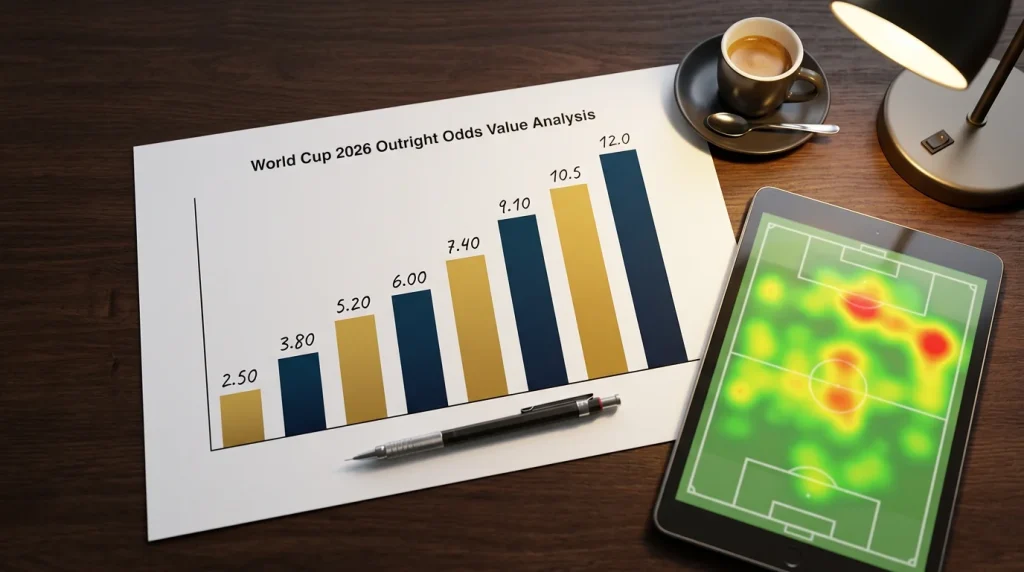
Before diving into the analysis, here is a snapshot of where the market stands. Argentina lead the outright World Cup 2026 odds at approximately 6.50 to 7.50 across major Australian operators, reflecting their status as defending champions and two-time consecutive major tournament winners. France sit close behind at 7.00 to 8.50, followed by England between 7.50 and 9.00. The next cluster includes Brazil (8.00 to 11.00), Spain (9.00 to 12.00), and Germany (11.00 to 15.00). The USA, boosted by host nation advantage, are typically priced at 15.00 to 19.00. The dark horse tier opens with the Netherlands (13.00 to 17.00), Portugal (11.00 to 13.00), and Colombia (21.00 to 26.00). These prices shift daily as money enters the market, but the relative hierarchy has been stable for months — which itself tells you something about how confident the bookmakers are in their models and how little new information has disrupted the pre-tournament consensus.
How Do World Cup Odds Actually Work?
I once asked an odds compiler at a major Australian bookmaker how he would describe his job to a stranger at a barbecue. His answer: “I sell opinions dressed up as maths.” That is the most honest description of the odds-making process I have ever heard, and it frames the central tension in any odds analysis — the numbers look objective, but the inputs are subjective.
Decimal odds — the standard format in Australia — express the total return on a winning bet per dollar staked. A price of 3.00 means a $1 bet returns $3 (your $1 stake plus $2 profit). To convert decimal odds into implied probability, you divide 1 by the price: 1 divided by 3.00 equals 0.333, or 33.3 per cent. This implied probability represents the bookmaker’s assessment of the team’s chance of winning, plus a margin. That “plus a margin” is the critical part that most casual punters overlook.
In a perfectly efficient market with no margin, the implied probabilities of all possible outcomes would sum to exactly 100 per cent. In reality, they sum to more — typically 105 to 115 per cent for World Cup outright markets, and 103 to 108 per cent for individual match markets. The excess above 100 per cent is the bookmaker’s overround, which is their built-in profit regardless of the outcome. When you see Argentina at 6.50, France at 7.50, England at 8.00, and so on down to Curaçao at 501.00, the sum of all 48 implied probabilities is not 100 per cent — it is closer to 130 per cent. That extra 30 per cent is the house edge, distributed across every team in the field.
Why does this matter for punters? Because the margin is not distributed evenly. Bookmakers tend to load more margin onto long shots than favourites — a practice called “favourite-longshot bias.” At a World Cup with 48 teams, roughly 30 of which are priced above 100.00, the margin on those long shots can be enormous in percentage terms. A team priced at 251.00 has an implied probability of 0.4 per cent, but their true probability might be 0.15 per cent. The bookmaker has more than doubled the implied chance relative to reality, pocketing the difference. For punters, this means the worst expected-value bets at the World Cup are typically the cheapest: backing a debutant at massive odds feels exciting but is mathematically the market’s most heavily taxed proposition.
Conversely, the margin on top favourites is often razor-thin because those lines attract the most money, the most scrutiny, and the most competition between operators. Argentina at 6.50 is probably within half a percentage point of their true probability. The action for punters is in the middle tier — teams priced between 12.00 and 40.00 — where the margin is moderate and the bookmaker’s model is most likely to disagree with an informed independent assessment.
Outright Winner: Where the Smart Money Should Go
In 2014, I backed Germany to win the World Cup at 8.00 — not because I loved their squad, but because the market had overreacted to their 4-4 draw with Sweden in qualifying and the price was two ticks longer than my model suggested it should be. They won the tournament. In 2018, I backed France at 7.50 on similar logic — the market undervalued their defensive solidity because it was obsessed with their attacking talent. They won too. In 2022, I backed Argentina at 5.50 because the Copa America victory had battle-hardened a squad that everyone else was treating as a nostalgic Messi farewell tour. Three tournaments, three outright winners, all backed on the same principle: find the favourite whose price is slightly longer than it should be, and trust the process.
For 2026, that principle leads me to two teams in the outright market and one that I am actively fading.
Argentina: the defend-the-title premium
Argentina are priced as favourite at roughly 6.50 to 7.50, implying a 13 to 15 per cent chance of winning. My model puts their true probability at approximately 14 to 16 per cent, which means the price is close to fair at the shorter end and marginally value at the longer end. The key variable is squad ageing — if two or three core players arrive at the tournament with reduced physical capacity, the true probability drops below the implied probability, and the bet becomes negative expected value. If they arrive fit, the experience of having won the last two major tournaments creates a compound advantage that no statistical model fully captures. I would back Argentina at 7.50 or longer but not at 6.50.
France: the value favourite
France’s price range of 7.00 to 8.50 is, in my assessment, the best value among the top three favourites. Their squad depth is the deepest in the tournament — potentially the deepest of any World Cup squad in history. They can absorb injuries that would cripple other nations because the replacement players are themselves world-class. The dressing room tension narrative is real but overstated; France’s 2018 World Cup win was accompanied by similar reports of internal friction, and the squad channelled it into performance rather than collapse. Group I (Senegal, Norway, Iraq) is tricky but navigable, and the bracket path from Group I avoids the heaviest concentration of favourites until the semi-finals. At 8.00 or longer, France are my primary outright position for the tournament.
England: the fade
England at 7.50 to 9.00 are the outright favourite I am fading most aggressively. The talent is undeniable, but the tournament track record suggests a systemic inability to convert deep runs into trophies. Two consecutive major tournament final losses are not bad luck — they are a pattern, and patterns at this level tend to reflect coaching decisions under pressure, penalty-taking preparation, and psychological resilience under the unique intensity of a final. Until England actually win something, their outright price should carry a discount that the market is not applying. I would not back England at any price shorter than 10.00, and even at that level, I would require a favourable bracket path confirmed by the group-stage results before committing.
The middle tier: where I am looking
The most interesting outright value in the 2026 World Cup sits in the 12.00 to 30.00 range, where the market’s margin is moderate and the potential for mispricing is highest. Spain at 9.00 to 12.00 are the European champions and play the most cohesive system football of any team in the tournament — their price is closer to fair value than the market typically offers for a reigning continental champion. Colombia at 21.00 to 26.00 are my speculative pick in this tier, based on their CONMEBOL qualifying form, squad quality, and a group (K) where topping Portugal is a realistic possibility. The Netherlands at 13.00 to 17.00 are roughly fair value — a team capable of reaching the semi-finals but unlikely to win the tournament.
The outright market at a 48-team World Cup is broader and flatter than at any previous edition. The favourite’s implied probability is lower, the number of viable contenders is higher, and the tail of the distribution (teams priced above 100.00) is longer. For punters, this means the optimal strategy is to spread outright exposure across two or three positions in different price tiers rather than concentrating on a single selection. A $50 bet on France at 8.00, a $30 bet on Colombia at 23.00, and a $20 bet on Morocco at 37.00 creates a portfolio with positive expected value across multiple scenarios — and crucially, it hedges against the single-selection risk that makes outright betting so volatile.
Group Winner Odds: Hidden Value or Fool’s Gold?
Last World Cup cycle, I placed more individual bets on group winner markets than on any other market type — and it was my most profitable category by return on investment. The reason is structural: group markets settle quickly (within two weeks of the tournament starting), the research burden is focused (four teams per group rather than 48), and the bookmakers’ models are demonstrably weaker for groups containing unfamiliar teams. The 2026 World Cup, with 12 groups and several featuring debutants or returning nations, expands this opportunity set by 50 per cent compared to 2022.
Not every group offers value, though. Here is where I see it and where I do not.
Groups where the market is right
Group A (Mexico, South Korea, South Africa, Czechia) is priced with Mexico as a comfortable favourite, and I agree. Mexico have home-region advantage (matches in Mexico City and nearby venues), deep tournament experience, and a squad that is well-suited to the CONCACAF style of football. South Korea are the most likely second-place finisher, and the gap between the top two and the bottom two is wide enough that the market has priced it accurately. There is no obvious value here.
Group E (Germany, Ecuador, Côte d’Ivoire, Curaçao) is similarly well-priced. Germany are heavy favourites, Ecuador are the likely runners-up, and neither Côte d’Ivoire nor Curaçao have the squad depth to sustain a challenge across three matches. The group winner market at approximately 1.60 for Germany offers no edge.
Group J (Argentina, Austria, Algeria, Jordan) is the most lopsided group in the draw, and the market knows it. Argentina should stroll through with nine points, and the group winner price at around 1.35 to 1.45 reflects a near-certainty. Backing Argentina to win Group J is tying up capital for minimal return — the very definition of fool’s gold.
Groups where the market is wrong
Group F (Netherlands, Japan, Tunisia, Sweden) is the group I am most excited about from a betting perspective. The market has the Netherlands as clear favourites at approximately 1.90 to 2.10, but Japan’s recent tournament record — beating Germany and Spain in the 2022 group stage — and their dramatically improved squad suggest the gap is narrower than the odds imply. Japan to win Group F at 3.50 to 4.00 represents genuine value if you believe, as I do, that their European-embedded squad has closed the quality gap with mid-tier European nations. Tunisia are an organised nuisance who could take points off anyone, and Sweden — while playoff-fatigued — bring a physical directness that disrupts possession-oriented teams. This group is a betting playground.
Group K (Portugal, Colombia, Uzbekistan, DR Congo) is another market I want to be involved in. Portugal are favoured at around 1.75, but Colombia’s CONMEBOL qualifying form and their track record of performing well at World Cups make them a legitimate group winner candidate at 2.80 to 3.30. The match between Portugal and Colombia will likely decide the group, and Colombia’s ability to control tempo and defend deep against technically superior opponents gives them a stylistic edge in that specific fixture. I rate Colombia’s probability of winning Group K at approximately 30 to 35 per cent — higher than the 25 to 28 per cent the market implies.
Group D (USA, Australia, Turkey, Paraguay) is of particular interest to Australian punters. The USA are priced as group favourites at roughly 1.70, which feels about right given home advantage and squad quality. The value for Australian punters lies not in the group winner market but in the “to qualify” market for the Socceroos, where early pricing of 2.10 to 2.40 underestimates Australia’s chances of finishing second or qualifying as a best third-placed team. I covered this in detail in my Socceroos analysis, but the bottom line is that the qualification line at 2.30 or longer is worth backing.
Group I (France, Senegal, Norway, Iraq) presents a less obvious opportunity. France will almost certainly win the group, but the battle for second between Senegal and Norway is priced as a coin flip at most operators. Senegal’s physical superiority, tournament experience, and defensive organisation make them a clearer second-place favourite than the 50-50 pricing suggests. If you can find Senegal to finish in the top two at 2.50 or longer, that is a position worth taking.
The broader principle with group markets is this: the tighter the group, the wider the margin, and the more likely the bookmaker has mispriced one or more outcomes. Lopsided groups are priced efficiently because the outcomes are predictable. Competitive groups are priced with wider margins because the outcomes are uncertain — and that margin creates the space where informed punters find edge.
Specials and Exotics: Do Top Scorer and First Goal Bets Pay Off?
At the 2018 World Cup, I watched a mate place a $20 bet on Harry Kane to win the Golden Boot at 11.00. Kane won it, the mate collected $220, and for the next four years he told everyone who would listen that Golden Boot bets were easy money. What he never mentioned was the seven other scorer bets he placed at that tournament — all losers — which meant his net profit across all scorer markets was about $60 after an outlay of $160. That is a 37.5 per cent ROI, which sounds decent until you realise it required one of the best strikers in the world to outscore 700 other players in a tournament. The variance is brutal.
The Golden Boot market at a 48-team World Cup becomes even more volatile. With 104 matches generating an estimated 180 to 195 goals, the total scoring volume rises, but it distributes across more players from more teams. The typical winning Golden Boot total at recent World Cups has been six to eight goals. In a 48-team tournament with more group-stage matches, that number might rise to seven to nine — but the range of possible winners expands too. A forward from a surprise quarter-finalist who scores five headers from set pieces is just as likely to win as the pre-tournament favourite. The market cannot account for this randomness, which is why Golden Boot pricing is one of the most heavily margined markets in the tournament.
First goalscorer bets for individual matches are a different proposition. These are single-event markets with a clearly defined outcome, and while the margin is still significant (typically 120 to 140 per cent overround for a match with 22 outfield players), the punter’s ability to use match-specific information — who takes penalties, who plays on the shoulder of the last defender, who attacks the far post from set pieces — can generate genuine edge. The key is to focus on matches where the goalscoring pattern is predictable: elite team versus debutant, where the favourite’s star forward is likely to start and play 70-plus minutes. In a group match between France and Iraq, for instance, backing a specific French attacker as first goalscorer is a higher-probability proposition than backing anyone in a tight Group K match between Portugal and Colombia where the first goal could come from a defensive midfielder’s deflected shot.
Exotic markets — most yellow cards in the group stage, fastest goal of the tournament, which team will be eliminated first — are entertainment bets with extreme margins and essentially no analytical edge. The fastest goal market, for example, is pricing a single moment across 104 matches that depends on kickoff routines, defensive lapses in the opening seconds, and pure chance. No model predicts this. No expertise improves your odds. If you enjoy these markets for the fun of having something to cheer for in every match, allocate a small amount and accept it as entertainment spending. If you are looking for expected value, look elsewhere — specials markets are where bookmakers make their highest margins per dollar wagered.

The Multi-Bet Trap: Are World Cup Multis Worth It?
I am going to say something that will be unpopular in every pub, TAB, and group chat in Australia: multi-bets are the single worst way to bet on the World Cup, and the expanded 48-team format makes them even worse. I know this because I have run the numbers on every multi structure I can think of across the last three tournaments, and the results are unambiguous. They are also deeply unflattering to my own record, because I have placed plenty of multis myself — always knowing, intellectually, that they were bad bets, and always falling for the same emotional trap that makes them irresistible.
The mathematical problem with multis is margin stacking. Every leg in a multi carries the bookmaker’s margin, and when you multiply legs together, you multiply margins together. A single match bet with a 106 per cent overround costs you roughly six per cent in expected value. A three-leg multi on three separate matches compounds that margin: 1.06 cubed equals 1.19, meaning the effective overround on your three-leg multi is 119 per cent. A five-leg multi pushes to 1.34, or 134 per cent. By the time you reach the ten-leg “mega multi” that social media influencers love to screenshot, the effective overround is approaching 180 per cent — meaning the bookmaker expects to keep roughly 45 cents of every dollar you stake, before a single ball is kicked.
The expanded World Cup makes this worse in two ways. First, 48 teams means more matches per day during the group stage, which means more legs to add and more temptation to build bigger multis. Second, the increased number of unfamiliar teams raises the upset rate in group-stage matches, which means more “banker” legs falling over. At the 2022 World Cup, Saudi Arabia’s victory over Argentina at 23.00 blew up millions of dollars worth of multi-bets worldwide in a single afternoon. At a 48-team tournament, the probability of at least one major upset per matchday is higher, and each upset kills every multi that included the losing favourite.
Does that mean you should never place a World Cup multi? No — but you should understand what you are doing. A multi is an entertainment product, not an investment strategy. If you allocate $20 to a four-leg multi for the fun of sweating every match that day, that is a perfectly reasonable use of discretionary spending. If you are allocating $200 to a ten-leg multi because the potential payout is $15,000 and you “have a feeling,” you are paying a premium for excitement that the mathematics guarantee will cost you money over time.
The smarter alternative for punters who enjoy the accumulator format is a reduced multi with correlated legs. Instead of chaining five random match results together, pick two or three outcomes that are logically connected — for example, backing two teams from the same tactical profile (defensive, organised, counter-attacking) in matches against similar opposition types. Correlated legs do not reduce the bookmaker’s margin, but they increase the probability that your selections share a common driver, which slightly improves the hit rate compared to random accumulation. It is not a magic formula. It is a way to enjoy the multi format without the worst of its mathematical penalties.
When Should You Place Your World Cup Bets?
Timing a bet is almost as important as selecting one, and this is something casual punters consistently undervalue. I learned the hard way at the 2014 World Cup, when I backed Colombia at 34.00 three months before the tournament — a price that shortened to 21.00 by kickoff as the market caught on to their squad quality. Had I waited until the last week before the tournament, I would have received nearly 40 per cent less return for the same assessment. The price moved against me because I was right early, which sounds paradoxical but is actually the norm in futures markets.
The general rule is that early money gets the best price on teams the market is undervaluing, and late money gets the best price on teams the market is overvaluing. In the months before the World Cup, outright odds are shaped primarily by public sentiment, historical reputation, and the bookmakers’ initial models — all of which favour established nations with large fan bases. As the tournament approaches, sharper money enters the market, and prices adjust toward true probability. Teams that were underpriced because of public demand (England, Brazil, Germany) tend to drift slightly, while teams that were overpriced because of obscurity (Colombia, Morocco, Japan) tend to shorten.
For the 2026 World Cup, my recommended timing strategy breaks into three phases. Phase one, now through April, is the window for early outright positions on teams you believe the market is undervaluing — Colombia, Morocco, and Japan are my primary candidates. These prices will shorten as pre-tournament media coverage increases demand. Phase two, May through early June, is the adjustment period when squad announcements, injury updates, and pre-tournament friendlies generate new information that moves individual match and group markets. This is the optimal window for group winner and qualification bets, because the data inputs are richer but the market has not yet fully processed them. Phase three, tournament time, is when match-specific bets become the primary opportunity. Live information — tactical setups observed in earlier group matches, injury updates, and confirmed lineups — creates inefficiencies in individual match markets that disappear within hours. The punter who watches the first round of group matches with a notebook and a plan will find more value in the second and third rounds than in any pre-tournament position.
The worst possible timing strategy is placing all your bets on the morning of the opening match, when the market is most heavily influenced by casual money and media hype. If you have not placed your outright positions before June, the value window has likely closed on most teams. If you wait until the knockout rounds to start betting, you have missed the group stage — historically the most profitable phase for informed punters.
Trust, Ignore, or Exploit? The Only Answer That Matters
The question in this article’s title — should you trust World Cup 2026 odds or ignore them — is deliberately provocative, because neither extreme is correct. Blindly trusting the odds means accepting the bookmaker’s model as gospel, margin and all, and placing bets that are mathematically guaranteed to lose over a large sample. Ignoring the odds entirely means betting on sentiment, loyalty, or gut instinct, which produces even worse results because at least the bookmaker’s model is grounded in data.
The right answer is to exploit the odds — to use them as a starting point for your own assessment, identify where the market’s implied probability diverges from your informed estimate, and act on the divergences that are large enough to overcome the margin. This is not easy. It requires research, discipline, and the emotional resilience to stick with your analysis when the tournament generates its inevitable upsets and dramatic swings. But it is the only approach that gives you a positive expected edge over the 39 days and 104 matches of the largest World Cup in history.
The specific World Cup 2026 odds positions I have outlined — France in the outright, Colombia and Japan in the group winner markets, Australia to qualify from Group D, and a disciplined avoidance of high-margin exotic and multi bets — represent my current best assessment of where value exists in the pre-tournament market. They will evolve as new information arrives, and I will update my positions accordingly. What will not change is the framework: find the gap between price and probability, and be there when it closes.
