
Estadio Azteca: Is the Opening Match Worthy of Its Legendary Legacy?
 Available in US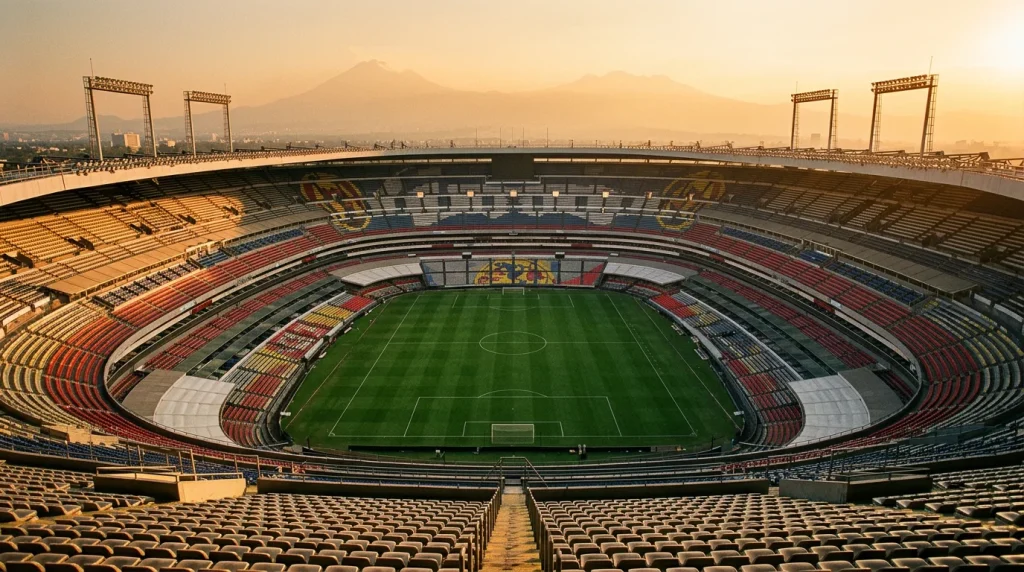
Table of Contents
On 11 June 2026, the referee will blow the whistle to start Mexico vs South Africa inside Estadio Azteca, and a stadium that has witnessed two of football’s most transcendent moments — Pelé’s 1970 triumph and Maradona’s 1986 masterpiece — will become the first venue in history to host three FIFA World Cups. No other ground on earth carries this weight. The Maracanã has hosted one World Cup final. Wembley has hosted one. The Azteca is about to host its third tournament, and the opening match is both a celebration of that legacy and a test of whether the stadium can still deliver at the highest level.
I have spent years studying World Cup venues, and the Azteca occupies a category of its own. It is not the biggest stadium in the tournament (MetLife holds more). It is not the most modern (SoFi Stadium in Los Angeles was built this decade). But no venue in world football carries a comparable emotional charge. The question for 2026 is whether emotion is enough — or whether the Azteca’s age and condition mean it is trading on nostalgia rather than merit.
Three World Cups: A Legacy That Belongs to No Other Stadium
Pelé scored the opening goal of the 1970 World Cup final inside the Azteca. Four years of goals, sixteen years of careers, an entire lifetime of football reduced to a single stadium on a single afternoon — and Pelé chose this ground to deliver what many consider the greatest team performance in World Cup history. Brazil’s 4-1 demolition of Italy that day established the Azteca as football’s most hallowed venue, a status that was cemented sixteen years later.
In 1986, Diego Maradona played two quarter-final matches at the Azteca that, taken together, represent the most extraordinary individual performance in the sport’s history. The “Hand of God” and the “Goal of the Century” against England — both scored within four minutes of each other — occurred on the same pitch that will host the 2026 opening ceremony. Four days later, Maradona led Argentina to the World Cup title on the same ground, cementing the Azteca’s status as the theatre where football’s greatest dramas unfold.
The 2026 tournament adds a third chapter. No other stadium has been entrusted with this role across three separate World Cups, and FIFA’s decision to place the opening match here — rather than in a newer, larger American venue — is an explicit acknowledgement that the Azteca’s historical significance outweighs its physical limitations. The opening ceremony, the first match, the first goal of the 2026 World Cup: all will happen in a stadium that has witnessed more iconic football moments than any other ground on the planet.
Is the Azteca Still World-Class — or Surviving on Reputation?
Walk into the Azteca today and you see a stadium that shows its age. Built in 1966, it has undergone multiple renovations — most recently a significant refurbishment in preparation for the 2026 World Cup — but the core infrastructure dates from an era when stadium design prioritised capacity over comfort. The seating is tighter than modern standards demand, the concourses are narrower than those in contemporary venues, and the sight lines from certain sections reflect 1960s architectural thinking rather than 21st-century fan experience design.
The capacity has been reduced from its historic peak of over 110,000 to approximately 83,000 following safety renovations. Even at this reduced figure, the Azteca remains one of the largest football-specific venues in the world, and its steep, enclosed bowl shape produces an acoustic intensity that modern open-air NFL stadiums cannot replicate. When the Azteca is full and the crowd is engaged, the noise is physical — a wall of sound that affects players’ communication and decision-making in measurable ways. Home teams at the Azteca have historically outperformed expected results by a significant margin, and much of that overperformance is attributed to the atmospheric conditions the stadium generates.
The altitude factor deserves specific attention. Mexico City sits at approximately 2,240 metres above sea level, and the Azteca’s playing conditions reflect that elevation. Visiting teams who are not acclimatised to altitude experience faster fatigue, reduced aerobic capacity and altered ball flight characteristics. For the opening match, Mexico’s familiarity with these conditions gives them a material advantage over South Africa — an edge that bookmakers incorporate into their match odds but that casual punters sometimes underestimate.
The renovation programme ahead of 2026 has addressed the most pressing concerns: seating replacement, structural reinforcement, improved lighting and broadcast infrastructure, upgraded hospitality areas and modernised changing facilities. The pitch — natural grass, as it has always been — has been re-laid to meet FIFA’s current standards. Critics argue that these improvements are cosmetic rather than structural, and that the Azteca’s fundamental limitations (narrow access points, limited disability access in older sections, ageing plumbing and electrical systems) cannot be resolved through renovation alone.
My assessment is that the Azteca in 2026 will be good enough but not great. It will deliver an atmosphere that no American venue can match — the combination of Mexican football culture, historical resonance and architectural design creates a sensory experience that is unique in world football. But the comfort level and operational efficiency will fall short of what fans experience at SoFi, MetLife or the newer Canadian venues. Whether “good enough” is acceptable for a World Cup opening match is a question that depends entirely on what you value more: history or modernity.
The Opening Match: Mexico vs South Africa on 11 June 2026
FIFA’s choice of Mexico vs South Africa as the opening fixture is deliberate symbolism. South Africa hosted the 2010 World Cup — the first on African soil — and the pairing echoes the 2010 opening match (also South Africa’s first game of their home tournament). For Mexico, the opening match in the Azteca represents a homecoming after decades of waiting for the World Cup to return.
From a betting perspective, the opening match carries specific characteristics that sharp punters recognise. World Cup openers since 1998 have tended to be cautious, low-scoring affairs: the average total goals in opening matches across the last seven tournaments is 2.14, with three of those seven matches ending 1-0. The combination of opening-ceremony nerves, the weight of global attention (the opening match draws the tournament’s largest single-game television audience outside the final) and the tactical conservatism that characterises hosts in their first fixture all point towards a tight match.
Mexico will be strong favourites. Their FIFA ranking, squad depth and home advantage — amplified by the Azteca’s altitude and atmosphere — make them the clear superior side on paper. South Africa’s qualification was built on defensive resilience and organisation rather than attacking flair, which suggests they will set up to contain Mexico and look for counter-attacking opportunities. The match odds should place Mexico around 1.50-1.65, with the draw around 4.00-4.50 and South Africa around 5.50-7.00.
The bet I like for the opening match is under 2.5 goals. The historical pattern of cautious opening fixtures, Mexico’s tendency to start tournaments slowly despite home advantage, and South Africa’s defensive approach all converge on a low-scoring outcome. Under 2.5 goals at approximately 1.80-1.90 captures the most likely match profile without requiring you to predict the winner.
Mexico City: Altitude, Culture and the Tournament Atmosphere
Mexico City is the largest metropolitan area in the Western Hemisphere, with a population exceeding 21 million. During the World Cup, the city will transform into a festival that dwarfs anything the American host cities can produce — not because of infrastructure, but because of cultural intensity. Mexican football culture is all-consuming, emotional and expressive in ways that American sports culture is not, and the atmosphere in the streets surrounding the Azteca on match days will be one of the tournament’s defining experiences.
For Australian fans considering the trip, Mexico City offers extraordinary value compared to New York, Los Angeles or other US host cities. Accommodation, food and transport are significantly cheaper, and the city’s culinary and cultural offerings are world-class. The altitude is the primary physical concern for travellers — acclimatisation takes 24 to 48 hours, and visitors should expect mild headaches, breathlessness during physical exertion and disrupted sleep patterns during their first night at elevation.
The time zone works reasonably well for Australian viewers. Mexico City operates on Central Time (UTC-6), which is 16 hours behind AEST. An evening match at 18:00 local time translates to approximately 10:00 AEST the following morning — not ideal, but manageable for anyone willing to adjust their Saturday or Sunday routine.
A Stadium That Has Earned Its Place — With Caveats
The Estadio Azteca deserves to host the World Cup 2026 opening match. Not because it is the best venue in the tournament — it is not — but because no other ground can claim its historical significance. Three World Cups, two of football’s most iconic moments, and a cultural connection to the sport that transcends architecture and engineering. The Azteca is football’s cathedral, and cathedrals are valued for their history as much as their facilities.
The caveats are real. The stadium’s age creates operational challenges that newer venues do not face. The altitude affects match quality in ways that purists dislike. The renovation, while substantial, cannot fully bridge the gap between 1966 design principles and 2026 expectations. And the opening match itself — Mexico vs South Africa — is unlikely to produce the kind of dramatic, high-scoring spectacle that a global audience craves from the tournament’s curtain-raiser.
But walk into the Azteca on 11 June 2026, feel the ground shake as 83,000 voices rise in unison, look at the pitch where Pelé lifted the trophy and Maradona danced through defenders, and tell me this stadium does not deserve this moment. The Azteca’s legacy is not a marketing exercise. It is earned, game by game, across six decades of the sport’s greatest occasions. The 2026 World Cup opening match adds one more line to a story that no other venue in football can tell.
