Are the Socceroos Genuine Contenders or Just Hopeful? A Deep Dive
 Available in US
Table of Contents
At 2:47 AM AEST on 2 December 2022, Mathew Leckie slid a shot past the Danish goalkeeper in Al Janoub Stadium, and an entire country collectively lost its mind. I was watching from a hotel room in London, three screens open — match feed, odds feed, social media — and my first thought was not “what a goal” but “what are the Socceroos going to be priced at for 2026?” That instinct tells you everything about how I approach tournaments: sentiment is a story, but odds are the test of whether the story is real.
Four years later, the Socceroos arrive at the 2026 World Cup in a position they have rarely occupied — as a team with genuine recent tournament pedigree. The Qatar 2022 campaign was not a fluke by any reasonable statistical measure. Australia accumulated six points in a group containing France, Tunisia, and Denmark, beat a European Championship semi-finalist, and were eliminated by the eventual champions only through a moment of individual brilliance from Lionel Messi. That is a foundation, not a fairy tale.
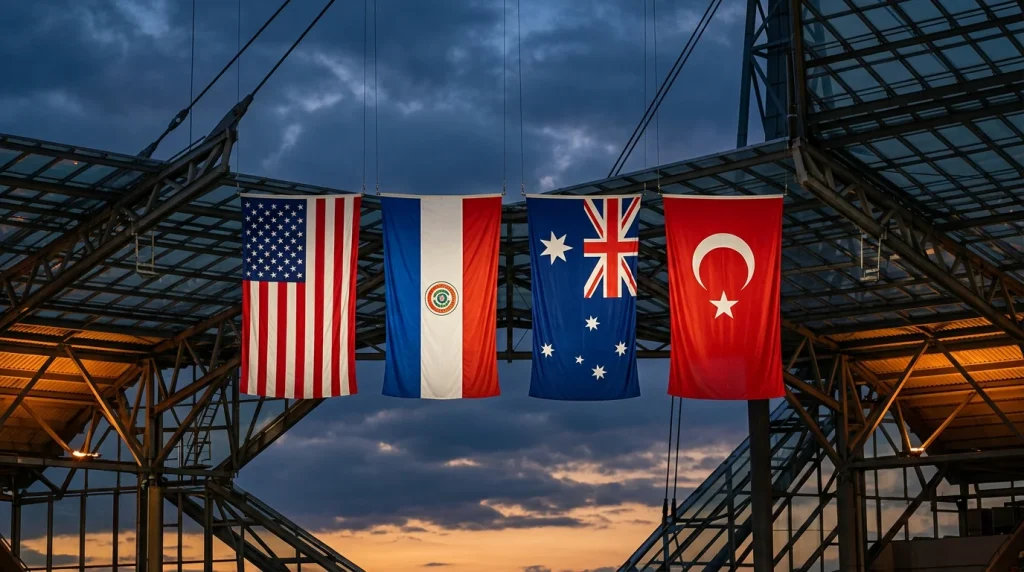
But foundations need to be built upon, and the question every Australian punter must answer before placing a single bet is whether this Socceroos squad has actually built anything on top of 2022 or merely dined out on the memory. Group D — featuring the United States as hosts, a volatile Turkey side, and a physical Paraguay team — offers a path to the round of 32 that looks favourable on paper. Paper, as any punter knows, does not play football. This is the analysis that decides whether backing the Socceroos at the 2026 World Cup is a calculated investment or sentimental charity.
Key Numbers: Socceroos at a Glance
Australia’s FIFA ranking heading into the 2026 World Cup sits in the mid-twenties — respectable but not intimidating. This will be the Socceroos’ sixth World Cup appearance in the modern era, following 2006, 2010, 2014, 2018, and 2022. Their record across those five tournaments reads: played 17, won 4, drawn 4, lost 9, with 17 goals scored and 27 conceded. The 2022 campaign in Qatar represented by far their best return, with two wins from three group matches and a genuine knockout-round appearance for only the second time. Group D at the 2026 tournament places them alongside the United States, Turkey, and Paraguay, with all three group-stage matches scheduled on the Pacific coast of North America — Vancouver, Seattle, and San Francisco.
Was Qatar 2022 a Fluke or a Foundation?
The night Australia beat Denmark 1-0, I pulled up the pre-tournament odds for that match. Denmark had been priced at 1.75 — implied probability of 57 per cent. Australia were out at 5.00, given roughly a 20 per cent chance. The draw absorbed the rest. In other words, the market expected Denmark to win comfortably, and when they did not, the instinct across the betting industry was to treat the result as an outlier. But one result is an outlier. Two results start looking like a signal.
Australia also beat Tunisia 1-0 in their opening group match, a game in which they controlled possession, limited chances, and looked organised in a way that Socceroos teams historically have not. Against France in the second match, they conceded early, equalised through Craig Goodwin, and then lost 4-1 as the defending champions shifted gears — a scoreline that flatters France more than it condemns Australia. The aggregate picture across three games is a team that defended with discipline, created chances efficiently against beatable opponents, and was outclassed only by the tournament’s best side. That is not a fluke profile. That is a team operating at the upper edge of its capability.
The statistical evidence supports this reading. Australia’s expected goals (xG) across the three group matches totalled approximately 3.2 for and 4.8 against — a ratio that is typical of a team finishing second in a World Cup group. Their pressing intensity, measured by PPDA (passes per defensive action), was among the highest of any team in the group stage, suggesting a deliberate tactical approach rather than fortunate results. Graham Arnold’s side came to Qatar with a plan, executed it, and earned their place in the round of 16 on merit.
The counterargument is that Qatar 2022 was played under unique conditions — a November-December window meant European-based players arrived mid-season rather than post-season, which arguably levelled the physical playing field. Denmark were also significantly underperforming their xG throughout 2022, making them a weaker opponent than their ranking suggested. And the format — 32 teams, groups of four, top two qualify — meant Australia only needed two wins from three matches against opponents who were all beatable on their day.
I give weight to both sides, but the balance tips toward “foundation” rather than “fluke.” The reason is what happened after Qatar. Australian football did not treat 2022 as a peak; it treated it as a proof of concept. The A-League’s alignment with European club calendars improved, the pathway from youth development to first-team selection became more structured, and the number of Socceroos players competing in European leagues reached an all-time high. If 2022 had been a fluke, you would expect a regression in the qualification cycle. Instead, Australia qualified for 2026 with relative comfort, finishing above regional rivals and avoiding the intercontinental playoff entirely. The trajectory is upward — the question is how steep.
Group D: Favourable Draw or Deceptive Comfort?
When the draw was announced and Australia landed in Group D with the USA, Turkey, and Paraguay, I watched the reaction across Australian punting circles with interest. The consensus was immediate: “best group we could have hoped for.” And the consensus was wrong — not because the group is bad, but because calling it “the best” reveals exactly the kind of complacency that gets teams eliminated.
Group D is favourable relative to alternatives. Australia avoided every major European power — no France, no Spain, no England, no Germany. They avoided South American heavyweights Argentina and Brazil. They landed on the opposite side of the bracket from the most loaded groups. On a scale of difficulty, Group D probably ranks somewhere between sixth and ninth out of twelve. That is good. That is not a gift.
USA: why they are dangerous
The United States are the group favourites, and they should be. Host nation advantage at the World Cup is one of the most statistically robust phenomena in tournament football. Since 1990, every host nation has advanced from their group, and three of the last eight hosts reached the semi-finals or better. The USA will play in front of enormous home crowds in Seattle (Lumen Field), a venue where the atmosphere is notoriously hostile for visiting teams. Their squad features a generation of players competing at the highest levels of European club football — playing in the Premier League, the Bundesliga, Serie A, and La Liga. The talent pool is deeper than any previous American squad, and the coaching setup has been building toward this tournament for four years.
The counterpoint: the USA have never advanced beyond the quarter-finals at a World Cup, and their most recent tournament appearance in 2022 ended with a round-of-16 exit to the Netherlands in which they barely created a chance. Home advantage generates crowd energy, not tactical intelligence, and the pressure of hosting can be as much a burden as a boost — ask Japan, who co-hosted in 2002 and lost in the round of 16 despite fervent home support. The USA are beatable. They are just not easily beatable.
Turkey: talent versus chaos
Turkey qualified for the 2026 World Cup through the European playoff route, beating Kosovo in a campaign that was more stressful than it needed to be. This is the defining characteristic of Turkish football at international level: immense talent, erratic execution. Their squad includes players from elite European clubs, and on their best day, Turkey can match any team in Group D for technical quality. On their worst day, they lose discipline, concede needless set-piece goals, and self-destruct in ways that make them a punter’s nightmare.
For Australia, Turkey represent the most dangerous opponent precisely because they are the least predictable. You can model the USA with reasonable confidence — their style, their strengths, their likely lineup. Paraguay are pragmatic and knowable. Turkey are a coin flip wearing a football kit. If the Socceroos draw them in the opening match on 14 June in Vancouver, the result could be anything from a comfortable Australian win to a Turkish masterclass, and neither outcome would shock me.
Paraguay: the matchup that matters most
If Australia are going to finish second in Group D — and second is the realistic target — the Paraguay match on 25 June is almost certainly the game that decides it. Paraguay qualified through the CONMEBOL pathway, finishing in the lower half of South American qualifying but above the cut-off. They are a physically robust, defensively organised side that will not be overawed by the occasion but lack the individual brilliance to dominate possession or create chances from nothing.
This is the type of opponent Australia historically struggles against: compact, hard to break down, and willing to absorb pressure before hitting on the counter. The Socceroos will likely need to win this match to qualify, which means they cannot afford the cautious, reactive approach that served them well against Tunisia in 2022. Aggression, early pressure, and a willingness to commit numbers forward will be essential — and that carries risk.
The overall Group D picture is a clear hierarchy with genuine uncertainty at every level. The USA should finish first but could stumble. Australia and Turkey are fighting for second, with Paraguay as the disruptor who could take points off anyone. The Socceroos’ path to the round of 32 runs through at least one win and probably a draw — a target that is achievable but far from guaranteed.
Squad Depth: Do the Socceroos Have Enough Firepower?
I was at a bar in Sydney last year when a bloke asked me — genuinely, no irony — whether Australia had “anyone playing in a good league.” I pulled up the squad list on my phone. The look on his face when I scrolled through the names was worth the price of the beer. The perception of the Socceroos as a team of A-League journeymen supplemented by one or two European-based players is outdated by at least a decade, and it is flatly wrong for the 2026 cycle.
Australia’s current squad features its highest-ever proportion of players competing in European leagues. The spine of the team is built around individuals with regular minutes in the English Championship, the Scottish Premiership, the Eredivisie, and various top-tier or second-tier leagues across the continent. This is not the same as having a squad full of Champions League starters — it is not, and pretending otherwise would be dishonest — but it does mean the Socceroos’ core players are accustomed to a pace, intensity, and tactical sophistication that previous Australian generations simply were not.
The attacking department has been the subject of the most debate. Australia’s historical weakness at World Cups has been an inability to score against organised defences — they managed just 17 goals across five tournaments before 2026, an average of one per game. The current generation offers more variety in the final third: pace on the flanks, a willingness to run behind defensive lines, and better technical quality in tight spaces. Whether that translates to goals against World Cup-level opponents is the central question, and it is one that the group stage will answer definitively.
In midfield, the depth is more encouraging. Australia’s ability to control the tempo of matches improved markedly during the qualification cycle, with central midfielders who are comfortable receiving under pressure and progressing the ball through the thirds rather than relying on long diagonals to target players. This evolution is partially tactical — a coaching shift toward possession-based play — and partially generational, as younger players raised in a more technical A-League academy system replace the direct, physical midfielders of previous eras.
Defensively, the Socceroos’ record during World Cup qualifying was solid without being spectacular. They conceded fewer goals than any other Asian confederation qualifier in the final round, built largely on a disciplined back line that prioritised shape over individual brilliance. The concern is that World Cup-level attackers exploit weaknesses that Asian opposition could not. The pace and movement of a Pulisic or a Turkish winger operating in space behind a committed full-back is a different proposition to anything the Socceroos faced in qualifying.
The goalkeeping position is settled and experienced, which matters more than people appreciate at tournament level. A goalkeeper who has been through a World Cup before — who understands the speed of the game, the crowd noise, the penalty shootout pressure — carries an intangible advantage that no statistic captures. Australia have that, and it should not be discounted.
The honest assessment of squad depth is that Australia have a strong starting eleven capable of competing with any team in Group D, and a bench that is adequate but not transformative. If injuries hit the spine of the team — particularly in central midfield or at centre-back — the drop-off to the replacement is steeper than it would be for the USA or Turkey. This is the unavoidable limitation of being a football nation ranked in the twenties rather than the top ten: the first choice is competitive, but the fifteenth choice is a genuine downgrade. Managing fitness and avoiding unnecessary risks in the opening match against Turkey will be critical to ensuring the best available squad is on the pitch for the decisive games.
Can Australia’s Style Compete at This Level?
Watch enough Socceroos matches and a pattern emerges that you either find reassuring or terrifying, depending on your tolerance for risk. Australia play a mid-block defensive structure — sitting deeper than the most aggressive pressing sides but higher than a classic low block — and rely on quick transitions to create chances. It is not beautiful football. It is not meant to be. It is football designed to frustrate opponents, absorb pressure in structured phases, and then strike when the opposition commits players forward.
This approach served Australia brilliantly in Qatar. Against Tunisia, they absorbed 56 per cent possession and still controlled the match through territorial pressing in key zones. Against Denmark, the same template produced a clean sheet and a goal from a rapid counter-attack that caught a team ranked fifteen places higher completely off guard. The style works against opponents who expect to dominate possession, because it invites them forward into areas where Australia’s defensive structure is most compact, then exploits the space left behind.
The debate is whether this reactive approach can survive an entire Group D campaign. The USA will play with intensity and crowd support, looking to press Australia high and force turnovers in dangerous areas. Turkey’s attacking talent is capable of unlocking a mid-block with individual brilliance — a dribble, a through ball, a moment of inspiration that no structure can prevent. Paraguay will sit deep themselves, which creates a tactical stalemate that Australia’s style is not designed to break.
I think the coaching staff recognises this and has been working on a secondary approach: a higher press and more aggressive possession play that can be deployed when the game state demands it. Evidence from recent friendlies and late-stage qualifiers suggests Australia are more comfortable holding the ball in the opposition half than they were in 2022, though the sample size is limited and the opposition quality was mixed.
The tactical verdict is that Australia’s base system — the mid-block counter-attacking approach — is their strongest asset and should be the default for the matches against the USA and Turkey. Against Paraguay, they will need a Plan B, and the quality of that Plan B will likely determine whether they finish second or third. A team that can only defend and counter is predictable over three matches. A team that can defend, counter, and then shift to controlled possession when required is genuinely dangerous. Whether the Socceroos have made that leap is the single most important tactical question heading into the tournament.
What Are the Bookies Saying — and Should You Listen?
I checked the Socceroos’ outright World Cup odds across four Australian bookmakers on the same morning, and the spread told me more than any tactical analysis could. The prices ranged from 101.00 to 126.00 — a gap that screams uncertainty. When bookmakers disagree by that much on the same team, it means their models are working with thin data and wide assumptions, which is exactly the environment where a punter with local knowledge can find edge.
Let me translate those numbers. An outright price of 101.00 implies a probability of just under one per cent — roughly one chance in a hundred of Australia winning the entire tournament. That sounds about right for a team ranked in the mid-twenties. Nobody is seriously suggesting the Socceroos will lift the trophy at MetLife Stadium on 19 July. But outright winner odds are not the only market, and for most Australian punters, they are not even the most interesting one.
Group qualification odds
The market that matters most for Socceroos backers is “to qualify from group,” which covers finishing first, second, or as one of the eight best third-placed teams. Early pricing has Australia somewhere between 2.10 and 2.40 across major operators — implying a 42 to 48 per cent probability of reaching the round of 32. That feels low to me, and I will explain why.
In a four-team group where one side (USA) is a clear favourite to finish first, the battle for second is essentially a three-horse race between Australia, Turkey, and Paraguay. If you assign the USA a 75 per cent chance of finishing in the top two (which most models do), the remaining qualification probability is distributed among the other three teams plus the third-place safety net. Australia’s combination of tournament experience, a slightly higher FIFA ranking than both Turkey and Paraguay, and the favourable Pacific coast time zones (matches at 07:00 and 12:00 AEST rather than 03:00 or 05:00) all nudge their true probability above the 45 per cent midpoint the market is offering.
My assessment puts Australia’s qualification probability closer to 52 to 55 per cent, which means the 2.30 line offers genuine value — not dramatic, but enough to warrant a stake if your bankroll management allows for group-market bets at this price range.
Match odds worth watching
The individual match odds tell their own story. Australia versus Turkey on 14 June is priced as a virtual coin flip, with the draw the most likely outcome. That match is where the Socceroos’ tournament begins and, potentially, where it ends. A win puts them in a commanding position; a loss makes the remaining two matches must-win affairs against tougher opposition. I would look at the draw-no-bet market for this match — removing the draw outcome and backing Australia at a slightly shorter price — as a way to express the view that Australia will not lose without taking on the full risk of needing them to win outright.
The USA versus Australia match on 20 June in Seattle is priced heavily in favour of the hosts, and rightly so. The value here is not in backing the Socceroos to win — it is in the unders line. Australia’s defensive structure is built to restrict chances, and the USA’s finishing has been inconsistent in recent tournaments. A match total under 2.5 goals is worth serious consideration in a fixture where Australia will prioritise not losing over chasing a win.
Player and specials markets
Socceroos-specific player markets are typically thin at most Australian bookmakers, but they expand significantly once the tournament begins. Anytime goalscorer lines on Australian attackers in the Paraguay match — the game most likely to produce an open contest — tend to offer better value than the same markets in the Turkey or USA fixtures, because the bookmakers price goalscorer odds partly on match context and partly on player reputation, and Australian forwards are consistently underpriced relative to their actual scoring rates against South American opposition.
Best Case, Worst Case, Most Likely: Three Socceroos Scenarios
Scenario planning is not prediction — it is a framework for thinking about how different outcomes cascade through a tournament bracket. I run three scenarios for every team I analyse, and for Australia, the range between best and worst case is wider than for most established nations, which tells you something about both the opportunity and the risk.
Best case: second in Group D, round-of-32 upset
Australia beat Turkey in the opener, take a creditable draw or narrow defeat against the USA, and then secure qualification with a result against Paraguay. They finish second in Group D with five or six points, enter the round of 32 with momentum and confidence, and draw an opponent from Group G — potentially Iran, Egypt, or New Zealand rather than Belgium. In this scenario, a round-of-32 win is genuinely plausible, putting the Socceroos into the round of 16 for only the second time in their history. Probability: approximately 20 per cent. This is not fantasy; it is the upside of a favourable draw and a squad playing to its ceiling.
Worst case: third in group, early exit
Australia lose the opener to Turkey — a match that could easily turn on a single set-piece error or a moment of Turkish individual brilliance — and then face the USA in Seattle needing a result against a fired-up host nation with home-crowd advantage. A second defeat makes the Paraguay match a must-win dead rubber with qualification depending on other results. In this scenario, Australia finish third with three points or fewer and miss out on the best-third-place calculation. They fly home after the group stage, and the 2022 heroics feel like a lifetime ago. Probability: approximately 25 per cent. The margin between this scenario and the best case is exactly one match result in the opener — which is why the Turkey fixture carries so much weight.
Most likely: qualification as a tight second or strong third
Australia draw with Turkey, lose narrowly to the USA, and beat Paraguay in the final match. They finish second on four points or, in some variants, third with four points and qualify as one of the eight best third-placed teams. Either way, they reach the round of 32 and face a significantly stronger opponent — likely the winner or runner-up of Group G, which could mean Belgium. A knockout-round exit follows, but the campaign is considered a success. Probability: approximately 40 per cent. This is the central expectation, and it is the scenario that most closely mirrors the 2022 pattern of solid group-stage performance followed by an honourable knockout defeat.
The remaining 15 per cent covers improbable outcomes in both directions — topping the group (unlikely but not impossible if the USA stumble) or finishing last (requires losing all three matches, which the squad’s defensive quality makes improbable). For punters, the most actionable insight from this scenario analysis is that Australia’s qualification probability is genuinely higher than the market suggests, because even the worst-case scenario includes a pathway through the third-place mechanism. The downside is protected; the upside is real.
Where to Put Your Money on the Socceroos
After nine years of analysing international tournaments, I have learned to distrust both optimism and cynicism equally. The Socceroos at the 2026 World Cup are neither the plucky underdogs the narrative demands nor the emerging force some local media would have you believe. They are a well-coached, moderately talented team with a favourable draw, genuine tournament experience, and a realistic path to the knockout rounds — nothing more, nothing less.
The value lies in the group qualification market, where the price does not fully reflect Australia’s combination of structural advantages: favourable time zones, a manageable group, and the third-place safety net that did not exist in previous formats. I would back the Socceroos to qualify from Group D at anything above 2.20 and consider the draw-no-bet market for the Turkey opener as a supporting position. The outright market is a sentimental bet, not a value bet — the probability of Australia winning the entire tournament is too low to justify a meaningful stake regardless of the price.
Are the Socceroos genuine contenders? No — not for the trophy. For a place in the round of 32 and a credible campaign that builds on 2022? Yes, and the odds say the market has not fully caught on yet. That is the gap between hope and edge, and it is worth exploiting.