
Are Multi-Bets Worth It for the World Cup — or a Punter’s Trap?
 Available in US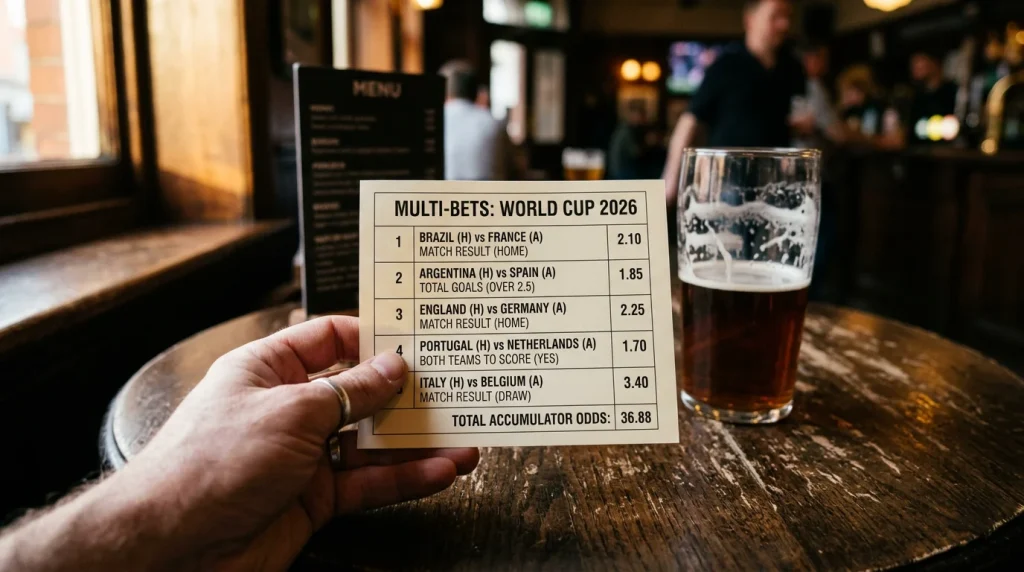
Table of Contents
A mate of mine once turned $10 into $2,400 on a six-leg multi during the 2018 World Cup. He still talks about it. What he never mentions is the roughly $1,500 he fed into failed multis across that same tournament, or the fact that his winning slip nearly died when South Korea beat Germany in the group stage and wiped out half his accumulators that week. That selective memory is the engine that keeps multi-bets alive in Australian punting culture — and it is particularly dangerous when a World Cup rolls around.
I have spent nine years dissecting international football markets, and every four years I watch the same pattern. The World Cup arrives, multi-bet volumes spike, and bookmakers quietly celebrate. Australians love a multi more than almost any other punting nation — the term is practically slang — and the 2026 World Cup, with 104 matches spread across 39 days, offers more legs than any tournament in history. More matches, more combinations, more excitement. But does more really mean better returns, or does it just mean a more elaborate way to lose?
This is not an anti-multi sermon. I place multis myself, occasionally, when the structure makes sense. But the gap between a multi-bet placed with intent and one placed on vibes is the gap between entertainment and self-deception. Let me walk you through exactly where that line sits for the 2026 World Cup.
What Exactly Is a World Cup Multi-Bet and How Does It Work?
Before I pull this apart, let me make sure we are speaking the same language. A multi-bet — called a parlay in American markets, an accumulator in the UK — combines two or more individual selections into a single wager. Every leg must win for the bet to pay out. Miss one, lose everything. The appeal is obvious: the odds multiply together, producing payouts that single bets simply cannot match.
Say you fancy three group-stage results at the 2026 World Cup. Argentina to beat Austria at 1.40, England to beat Croatia at 1.75, and Brazil to beat Scotland at 1.55. As singles, none of those prices gets the blood pumping. But roll them into a multi and you are looking at combined decimal odds of roughly 3.80 — a $50 stake returns $190. The maths is straightforward multiplication: 1.40 times 1.75 times 1.55. Each leg amplifies the next.
Australian bookmakers offer multis with as few as two legs and, in some cases, up to fifteen or more. During a World Cup, the temptation to stack legs is enormous because you have multiple matches running on the same day, all within the same sport, all feeling connected. A four-leg multi on a single matchday of group-stage fixtures feels less like gambling and more like informed prediction. That feeling, as I will explain, is doing a lot of heavy lifting for the bookmaker’s margin.
One critical detail for Australian punters: because in-play online betting is prohibited under the Interactive Gambling Act, you cannot add live legs to a multi during a match. Your multi is locked before kickoff. This removes the dynamic element that punters in other jurisdictions exploit, where you might add a halftime leg based on what you have seen on the pitch. In Australia, your World Cup multi lives or dies on pre-match analysis alone.
Why World Cup Multis Feel So Tempting — and Why That Matters
I once asked a behavioural psychologist who studies gambling why multi-bets outsell singles by such a wide margin in Australia. Her answer was blunt: “Because humans are terrible at multiplying probabilities but excellent at imagining payouts.” That single sentence explains more about multi-bet popularity than any market report I have read.
The World Cup amplifies every psychological trigger that makes multis attractive. First, there is the narrative factor. A tournament creates storylines — the defending champions, the host nation, the dark horse — and multis let you bet on the story you believe in. Backing Argentina, France, and Brazil to all win their opening group matches is not just a wager; it is a worldview, a statement about how you think football works. That emotional investment makes the bet stickier than any rational analysis would justify.
Second, social media has turned World Cup multis into a spectator sport of their own. Screenshots of potential payouts circulate constantly. A $5 ten-leg multi returning $15,000 looks spectacular as a screenshot. Nobody posts the nine identical slips that died in the first leg. The survivorship bias is staggering: for every viral winning multi, thousands of identical structures have quietly lost. But the algorithm does not show you the losers, so your perception of multi-bet success rates is wildly inflated.
Third, there is the sheer volume of the 2026 tournament. With 104 matches, you can construct a fresh multi every single day for 39 days. Each matchday brings three or four fixtures, each one a potential leg. The dopamine cycle never stops — a losing multi in the morning is replaced by a new one for the afternoon session. This rapid turnover creates a drip-feed of excitement that masks cumulative losses remarkably well.
Fourth, and most specific to Australia, major bookmakers actively promote multi-bet features during World Cups. Multi-builders, bonus-bet offers for multi-bets, and “same game multi” tools dominate the interface. Despite the new advertising restrictions introduced in April 2026, these features remain prominent within the apps themselves for logged-in users over 18. The product design nudges you toward multis because multis generate higher margins for the operator. Understanding why multis feel good is the first step toward deciding whether they actually are good.
The Maths Problem: Why World Cup Multis Usually Lose
Here is a number that should change how you think about multi-bets forever: a bookmaker’s margin on a single head-to-head football market in Australia typically sits between 4% and 7%. On a multi, that margin does not just add — it compounds. Each leg multiplies the overround into the next, and by the time you reach a five-leg multi, the effective margin the bookmaker holds over you can exceed 25%. You are not fighting a small house edge. You are fighting a wall.
Let me make this concrete with a World Cup example. Suppose there are four group-stage matches on a given day, and you build a four-leg multi backing the favourite in each. The true probability of all four favourites winning might be around 30% based on your own model. But the bookmaker’s odds, once margin is baked in, imply a combined probability lower than what they actually believe. The difference between the true combined probability and what the odds pay you is the bookmaker’s compounded edge — and on a four-leg multi, that gap is substantial.
Think of it this way. If you flip a coin and I offer you 1.90 instead of 2.00, I am skimming 5% on a single flip. Not devastating. But if I offer you 1.90 on each of four consecutive flips and you need all four to be heads, my edge is not 5% — it is closer to 19%. The maths is not intuitive, which is precisely why it works so well for the bookmaker. Every leg you add is another layer of margin stacked against you.
The myth that needs dismantling is this: “I only pick strong favourites for my multi, so it’s basically safe.” Strong favourites at decimal odds of 1.20 to 1.40 feel like near-certainties individually. But string five of them together and your combined probability is often between 35% and 50%. That is a coin-flip disguised as a confident prediction. And because the individual odds are short, the combined payout is not even particularly impressive — you might be risking $100 to win $250 on what amounts to a fifty-fifty proposition. The risk-reward ratio deteriorates rapidly as you stack short-priced legs.
I tracked my own World Cup multi-bets across the 2018 and 2022 tournaments. In total, I placed 23 multis. Three won. My net position after both tournaments was negative $340. The three winners felt euphoric; the twenty losers barely registered individually. That is the trap. The emotional accounting does not match the financial accounting. Each loss was small enough to dismiss, but they accumulated into a meaningful deficit that three wins could not cover.
The expanded 2026 format with 48 teams introduces another mathematical problem: more matches involving mismatched teams. When a heavily favoured side plays a debutant, the odds are so short that including that leg in a multi adds almost no value to the payout but still introduces non-trivial risk. Upsets happen at every World Cup — Saudi Arabia beating Argentina in 2022 paid 17.00 — and a single upset anywhere in your multi kills the entire slip. More matches means more opportunities for one rogue result to destroy your accumulator.
When a World Cup Multi Actually Makes Sense
After all that, you might expect me to say never touch a multi again. I will not, because there are specific scenarios where the structure is defensible — and the 2026 World Cup creates a few of them.
The first is the correlated-outcome multi. Standard multis assume each leg is independent, but some World Cup outcomes are linked. If you believe a particular group will produce low-scoring, defensive football — say Group I with France, Senegal, Norway, and Iraq — then backing the under 2.5 goals across multiple matches in that group is not stacking independent events. The underlying cause (cautious group-stage tactics, evenly matched sides, a shared defensive culture in the group) connects the legs. Bookmakers price most multi legs as if they are independent, so genuine correlation can tilt expected value in your direction.
The second is the entertainment multi with strict bankroll limits. If you allocate a fixed, small amount — say $20 for the entire tournament — and treat multis as a social activity rather than an investment strategy, the maths hardly matters. The expected loss on $20 worth of multis across a month-long tournament is a rounding error in your entertainment budget. The problem arises when entertainment spending silently escalates, which is why a hard pre-tournament cap matters.
The third is the two-leg or three-leg multi where every selection represents genuine assessed value, not just a favourite you like. If your analysis suggests a team is underpriced in a specific market — say, the Socceroos to beat Paraguay at odds you consider too generous — combining two or three such value bets can be rational. The margin compounding effect is relatively small on two or three legs, and if each individual selection carries positive expected value, the multi retains positive expected value too. The moment you start adding legs for the sake of a bigger number on the potential payout line, you have crossed from strategy into hope.
The fourth, and perhaps most overlooked, is the same-game multi built around a single World Cup fixture where you understand the tactical dynamics deeply. If you have studied the matchup between the Netherlands and Japan in Group F and you expect Japan to play a high press that leaves space in behind, combining “Japan over 0.5 goals” with “over 2.5 total goals” and “both teams to score” reflects a single coherent thesis. The legs are correlated by design, and the combined payout can exceed what the individual risk justifies. This structure works best when your tactical read is specific and data-supported, not when you are guessing.
Smarter Alternatives: Same Excitement, Better Odds?
The dirty secret of multi-bets is that the excitement they generate has almost nothing to do with the structure and almost everything to do with having skin in the game across multiple events. You can replicate that feeling without the compounding margin penalty.
The simplest alternative is a singles strategy with equal stakes. Instead of putting $50 on a four-leg multi, place four $12.50 singles on the same four selections. If three of four win, you still profit. If two win, you lose less than you would have on the multi. You only underperform the multi in the scenario where all four win — and as I have explained, that scenario is rarer than your brain wants you to believe. The singles approach delivers more frequent, smaller wins, which keeps the dopamine flowing without the all-or-nothing volatility.
Another option is the dutching approach, where you spread a stake across several outcomes in the same market to guarantee a return if any of your selections wins. For World Cup group winner betting, dutching two teams in a tight group can lock in value regardless of which one tops the table. It is less glamorous than a multi but considerably kinder to your bankroll.
System bets — sometimes called “trixies” or “patents” depending on the combination — allow multi-style structures where you do not need every leg to win. A three-selection system bet, for example, pays out on doubles within your selections even if one leg loses. Australian bookmakers offer these, though they are often buried deeper in the interface than the multi-builder because they carry lower margins for the operator. That alone should tell you something about which product benefits whom.
Finally, consider reducing your multi to two legs maximum. The margin compounding on a two-leg multi is modest — often comparable to what you face on a single bet in a less liquid market. If you genuinely have two World Cup selections you believe carry value, a double is a mathematically defensible structure. It is three legs and beyond where the bookmaker’s edge accelerates sharply. Discipline with leg count is the single most impactful change an Australian punter can make to their World Cup multi-bet habit.
The Honest Answer on World Cup Multi-Bets
Multi-bets are not inherently a trap, but they are a trap for anyone who does not understand the margin mechanics. The 2026 World Cup will generate more multi-bet options than any football tournament in history — 104 matches across 39 days is a multi-builder’s paradise and a bookmaker’s dream. If you are going to play, play with two or three legs maximum, only on selections where you have identified genuine value, and with a pre-set tournament budget you are comfortable losing entirely. Treat the multi as what it is: a leveraged bet with compounding costs. Used sparingly and with discipline, it belongs in a punter’s toolkit. Used habitually and emotionally, it is the most efficient way to donate money to a licensed bookmaker over the course of a month-long tournament.
