
BC Place and Lumen Field: Do the Socceroos’ Venues Give Them an Edge?
 Available in US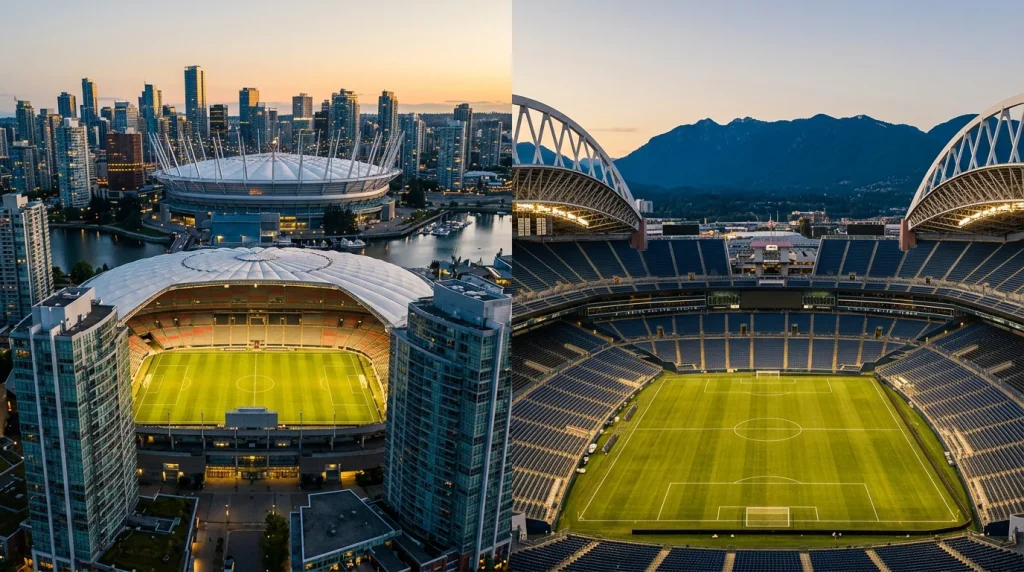
Table of Contents
The Socceroos’ World Cup 2026 base camp sits on North America’s Pacific coast — a region that shares more climatic DNA with Melbourne than with Miami. Vancouver’s BC Place hosts the opening fixture against Türkiye. Seattle’s Lumen Field stages the marquee clash against the USA. And San Francisco’s Levi’s Stadium completes the trilogy with the decisive group match against Paraguay. For Australian supporters setting alarms and booking flights, the geography of Group D is arguably the friendliest draw the Socceroos could have received — and the venues themselves carry characteristics that could influence results in ways the odds do not fully capture.
BC Place, Vancouver: Where Australia’s Campaign Begins
Your first World Cup match as a fan stays with you permanently. I still remember every detail of the first tournament match I attended — the walk to the stadium, the noise building as you approach the gates, the moment the teams emerge from the tunnel. For thousands of Australians travelling to the 2026 World Cup, that moment will happen at BC Place on 14 June, when the Socceroos face Türkiye in their opening Group D fixture.
BC Place is a retractable-roof stadium in downtown Vancouver with a capacity of approximately 54,500 for football configuration. That makes it one of the smaller World Cup venues, which — counterintuitively — could benefit the Socceroos. Smaller stadiums produce concentrated noise. The roof, when closed, traps sound and creates an intensity that open-air stadiums of similar capacity cannot match. If the Australian contingent in Vancouver is significant (and early travel booking data suggests it will be), BC Place’s acoustics could amplify their presence beyond what the numbers alone would suggest.
The stadium’s location in downtown Vancouver is a significant practical advantage for travelling supporters. Unlike MetLife in New Jersey or Levi’s Stadium in suburban Santa Clara, BC Place sits within walking distance of the city’s main hotel district, restaurants and public transport. Fans can walk from their accommodation to the stadium in 15 to 20 minutes, eliminating the logistical complexity that plagues suburban venue fixtures. The SkyTrain rapid transit system stops directly adjacent to the stadium for those staying further out.
Playing conditions at BC Place favour controlled, technical football. The retractable roof eliminates weather variables — no wind, no rain, no extreme heat — and the temporary natural grass surface benefits from the controlled environment. For Australia, whose defensive system relies on positional discipline and structured movement, the predictable playing conditions at BC Place remove environmental factors that could disrupt their game plan. Türkiye, whose attacking creativity can be blunted by difficult pitch conditions or adverse weather, will also benefit from the controlled environment — but their emotional volatility is less about conditions and more about mentality, which no roof can fix.
The AEST kick-off time for Australia vs Türkiye at BC Place is approximately 14:00 on a Sunday — the most viewer-friendly slot in the entire Group D schedule. SBS’s free-to-air coverage means that every Australian pub, club and living room can tune in without requiring a streaming subscription or satellite dish. If the Socceroos are going to capture the nation’s attention the way they did during the 2022 World Cup, this is the fixture that sets the tone.
Lumen Field, Seattle: The Loudest Stadium in North America
Lumen Field holds a Guinness World Record. During a 2013 NFL match between the Seattle Seahawks and San Francisco 49ers, the crowd noise inside the stadium registered 137.6 decibels — louder than a jet engine at takeoff. The stadium’s design, with partially covered seating that reflects sound back onto the pitch and steep upper tiers that compress the acoustic energy downward, makes Lumen Field the most hostile venue for visiting teams in all of North American professional sport.
On 20 June 2026, the Socceroos walk into that cauldron to face the USA. The Americans will treat this as a home match in every sense: the vast majority of the 69,000 capacity will be wearing red, white and blue, and the atmospheric advantage will be tangible. For Australia’s players — most of whom play their club football in front of European crowds that rarely exceed 30,000 — the sensory overload of Lumen Field will be a genuine competitive factor.
The stadium sits in Seattle’s SoDo district, south of the downtown core, with excellent public transport access via Link Light Rail. Seattle’s climate in late June is temperate — average highs around 21 to 23 degrees Celsius, low humidity, and long daylight hours that extend past 21:00 local time. These are near-ideal playing conditions for international football, and they suit Australia’s style. The Socceroos perform better in moderate temperatures than in the extreme heat of Middle Eastern or tropical venues, and Seattle’s Pacific Northwest climate should allow them to maintain pressing intensity deeper into matches than they managed during the 2022 World Cup in Qatar’s controlled-cooling stadiums.
The betting angle on the USA vs Australia match at Lumen Field centres on the home advantage premium. Bookmakers typically add 5 to 8 percentage points to the home team’s implied probability for World Cup matches played on home soil, and Lumen Field’s specific atmospheric characteristics might justify an even larger adjustment. If you believe the crowd factor alone is worth an additional margin, the USA’s match odds will look fair. If you believe Australia’s tournament experience and defensive discipline can withstand the noise, the Socceroos’ odds — likely around 4.50-5.50 for a win — carry value that the atmospheric data does not fully account for.
The AEST timing for this fixture is approximately 07:00 on a Saturday morning. That is early, but not unreasonable — the kind of alarm-clock match that Australians set up with coffee, toast and nervous anticipation. For punters placing bets, the timing means that in-play markets (available only by phone for Australian bettors under IGA regulations) will coincide with the morning rush, which may thin the available phone-betting lines compared to afternoon or evening fixtures.
Levi’s Stadium, San Francisco: Where It All Gets Decided
The final group match — Paraguay vs Australia on 25 June — takes place at Levi’s Stadium in Santa Clara, approximately 65 kilometres south of San Francisco. This is the venue where the Socceroos’ World Cup campaign will be defined, and its characteristics are worth understanding in detail because matchday three is where group-stage betting markets typically offer the sharpest value.
Levi’s Stadium is a 68,500-seat open-air venue that serves as the home of the San Francisco 49ers. Unlike BC Place’s controlled environment or Lumen Field’s acoustic fortress, Levi’s is a modern, corporate stadium built for the Silicon Valley market. The atmosphere at Levi’s for non-NFL events is noticeably less intense than at Lumen Field — the corporate culture of the surrounding area and the stadium’s design produce a more subdued match-day experience.
For the Socceroos, that relative neutrality could be an advantage. A Paraguay vs Australia match in Santa Clara will not carry the hostile home-crowd factor of the USA fixture in Seattle. The Australian and Paraguayan supporter contingents will be more evenly matched in a venue that neither team considers home territory, and the absence of a dominant crowd allegiance could allow the match to be decided on footballing merit rather than atmospheric pressure.
Late June in Santa Clara brings warm conditions — average highs around 27 to 29 degrees Celsius — though the low humidity of the Bay Area makes the heat more manageable than equivalent temperatures in the American South or Midwest. Levi’s Stadium’s open-air design means that late afternoon or evening kick-offs will benefit from cooling temperatures as the sun drops, but a midday start (which the scheduling may require) could produce on-pitch temperatures that test both teams’ fitness levels.
The AEST kick-off for this match is approximately 12:00 midday — lunchtime viewing for Australian fans, and a perfectly convenient slot for both watching and betting. If the Socceroos need a result to qualify, this is the match where the entire nation will be watching, and the noon timing means pubs and workplaces across the country will be tuned in simultaneously.
AEST Match Times: The Complete Socceroos Schedule
| Date | Match | Venue | AEST (approx.) |
|---|---|---|---|
| 14 June 2026 | Australia vs Türkiye | BC Place, Vancouver | 14:00 Sunday |
| 20 June 2026 | USA vs Australia | Lumen Field, Seattle | 07:00 Saturday |
| 25 June 2026 | Paraguay vs Australia | Levi’s Stadium, San Francisco | 12:00 Thursday |
All three Group D matches involving Australia take place on the Pacific coast, which produces AEST times ranging from early morning to mid-afternoon. Compare this to a hypothetical Group D hosted on the East Coast — where evening kick-offs in New York would translate to 3:00 or 5:00 AM AEST — and the scheduling advantage becomes clear. The Socceroos’ group is one of the most viewable for Australian audiences in the entire tournament.
Do These Venues Help or Hurt the Socceroos’ Chances?
A common misconception in World Cup analysis is that venues are neutral factors. They are not. Climate, altitude, crowd composition, stadium acoustics and travel distances between fixtures all contribute to match outcomes in ways that aggregate data models struggle to capture but that experienced tournament analysts recognise intuitively.
The Socceroos’ venue draw offers three distinct advantages. The Pacific coast climate suits their playing style — temperate conditions that allow sustained pressing without the heat-related fatigue that affected their 2022 campaign. The geographic proximity between Vancouver, Seattle and San Francisco minimises travel disruption between group matches — all three cities are connected by short domestic flights under three hours, meaning the squad can maintain training routines without the jet-lag disruption that affects teams crossing multiple time zones between fixtures. And the AEST viewing times maximise the domestic audience, which — while not a direct competitive factor — creates the kind of national engagement that players are aware of and respond to.
The disadvantage is Lumen Field. Playing the USA in the loudest stadium on the continent, in front of a crowd that will be overwhelmingly hostile, is a genuine competitive hurdle. The Socceroos’ players will need to rely on pre-set tactical patterns and visual communication during that match, because verbal communication on the pitch will be close to impossible during periods of sustained American pressure. Teams that have played at Lumen Field in MLS and international friendlies consistently report that the noise level is disorienting for the first 15 to 20 minutes — precisely the period when World Cup matches are most volatile.
On balance, the venue assignment is a net positive for Australia. Two of three fixtures offer manageable to favourable conditions, and even the Lumen Field challenge is mitigated by the Socceroos’ tournament experience and defensive discipline. If Australia qualify from Group D, the venue draw will have played a small but real part in that achievement — a factor that most pre-tournament analysis overlooks but that punters alert to venue dynamics can use to sharpen their betting positions.
