
Was Rodri’s Golden Ball the **Biggest Betting Upset** of World Cup 2026?
 Available in US
When the 2026 World Cup final kicked off on 19 July, Lionel Messi was the overwhelming favourite to win the Golden Ball at approximately $1.11. By the time the trophy ceremony concluded, it was Spain’s Rodri — priced at around $11.00 pre-final — who lifted the tournament’s best player award. Messi, held scoreless in the final, took the Silver Ball. Kylian Mbappé, who won the Golden Boot with 10 goals and broke the all-time World Cup scoring record, claimed the Bronze Ball.
For Australian punters who stayed awake until dawn on 20 July AEST to watch the ceremony, the question is unavoidable: was Rodri’s Golden Ball win the biggest betting upset of the tournament — or did the market simply misprice a midfielder who captained the champions and set a new single-tournament passing record?
We break down the case for and against, examining whether the $11.00 Golden Ball longshot was a genuine shock or a value play the market missed.
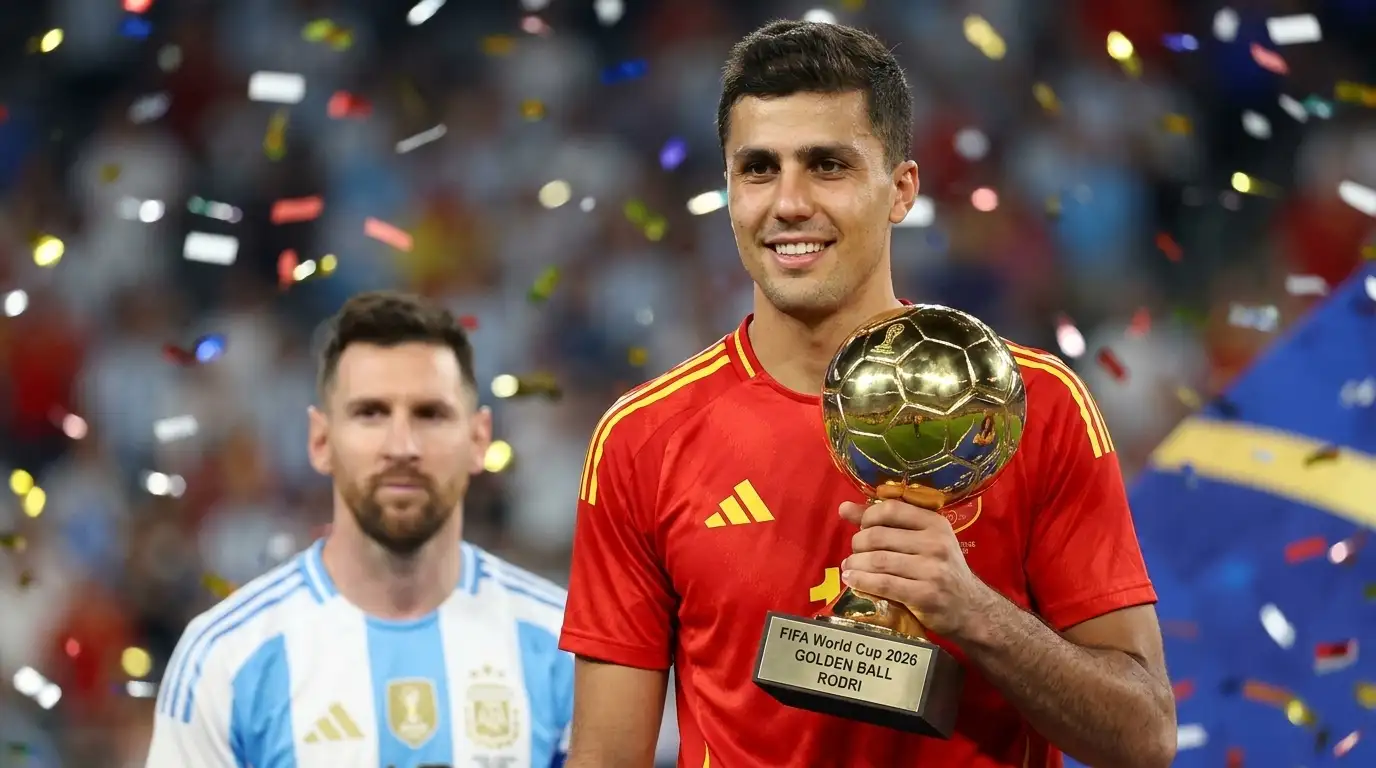
- Rodri won the Golden Ball as Spain’s captain after an ACL comeback, priced at approximately $11.00 (+1000) before the final.
- Messi was the pre-final favourite at around $1.11, implying a 90% probability — he finished with the Silver Ball after being held scoreless in the final.
- Mbappé won the Golden Boot (10 goals, all-time record 22 career WC goals) and took the Bronze Ball despite France finishing fourth.
- Every other award went to the favourite: Spain lifted the trophy ($1.67), Mbappé won the Boot ($1.04), Unai Simón won the Glove ($1.13). The Golden Ball was the only major market where the favourite failed.
- Rodri’s tournament: 756 completed passes (single-edition record, past Xavi’s 599), 1,343 career WC passes (all-time record), captained Spain to their second World Cup with just one goal conceded in eight matches.
For: Yes, It Was the Tournament’s Biggest Upset
Messi at $1.11 implied a 90% probability — the market had him as a near-lock
Pre-final Golden Ball odds had Messi at approximately $1.11, meaning the market priced him at a 90% probability to win the award. In betting terms, a 90% favourite losing is a significant upset — it’s not a coin flip or a close call, it’s a market misjudgement of the highest order.
Compare that to other tournament outcomes: Spain won the final at $1.67 (59.9% implied), Mbappé won the Boot at $1.04 (96.2% implied), Simón won the Glove at $1.13 (88.5% implied). The Golden Ball was the only award where a near-lock favourite was overturned. That makes it, by definition, the biggest upset of the tournament’s major markets.
Messi’s narrative heading into the final was overwhelming
Messi entered the final with 8 goals and 4 assists, having just scored a hat-trick in the semi-final against England. He was one goal from a potential Golden Boot (though Mbappé’s bronze-game brace had already pushed him to 10). The pre-final storyline was Messi’s fairy-tale ending: win the World Cup again at 39, claim the Golden Ball in his final tournament, and cement his legacy as the greatest of all time.
The market wasn’t just pricing Messi’s tournament performance — it was pricing the narrative. A 39-year-old superstar in his last World Cup, leading Argentina to a potential back-to-back title, with the individual award within reach. That’s why he was $1.11. The fact the narrative collapsed in 120 scoreless minutes makes the upset even sharper.
Rodri wasn’t even the second or third name in the conversation before the final
Pre-final Golden Ball discussion centred on Messi, with Mbappé as the distant alternative if France somehow won and Mbappé outscored Messi in the final. Rodri, priced at $11.00, was barely in the conversation. He was Spain’s captain and midfield anchor, but the market’s attention was on goalscorers and playmakers — not a defensive midfielder whose primary contribution was breaking up play and recycling possession.
If you polled 100 casual punters before the final, fewer than ten would have named Rodri as a Golden Ball contender. The award going to an $11.00 outsider who wasn’t part of the pre-match narrative is the definition of an upset.
The other three major markets all delivered the favourite — this was the outlier
Spain won the tournament at $1.67 (favourite). Mbappé won the Golden Boot at $1.04 (heavy favourite). Unai Simón won the Golden Glove at $1.13 (favourite). Pau Cubarsí won Best Young Player (though Lamine Yamal was the higher-profile name, Cubarsí was listed). Every single major award market delivered the favourite or a short-priced name — except the Golden Ball.
That makes Rodri’s win the tournament’s standout upset. The market got everything else right and missed the biggest individual award. For Australian punters who took Rodri at $11.00, it was the play of the tournament. For those who took Messi at $1.11, it was the most expensive mispricing of World Cup 2026.
Against: No, the Market Mispriced Rodri — He Was the Value Play
Rodri captained the champions, set two passing records, and anchored the best defence in tournament history
Rodri finished the tournament with 756 completed passes — breaking Xavi’s 2010 single-edition record of 599. His 1,343 career World Cup passes surpassed Dunga’s all-time mark of 1,306. He captained Spain to the title with just one goal conceded in eight matches — the fewest ever by a World Cup winner. Spain’s 38-match unbeaten run is an outright international record.
The Golden Ball is awarded to the tournament’s best player, not the best attacker. Rodri was the engine of the tournament’s best team, the leader of a historic defence, and the holder of two passing records. If the market had priced him based on his actual contribution rather than his lack of goals, $11.00 was far too long. The "upset" was actually a value correction.
The award has a history of going to defensive midfielders and playmakers, not just goalscorers
The Golden Ball doesn’t always go to the top scorer. In 2010, Diego Forlán won it over Spain’s goalscorers. In 2014, Messi won it despite Germany lifting the trophy. In 2018, Luka Modrić won it over the tournament’s top scorers. The award rewards overall contribution, not just goals.
Rodri’s 756 completed passes, his captaincy, and his anchoring of a defence that conceded one goal in eight matches is exactly the profile of a modern Golden Ball winner. The market at $11.00 mispriced him because casual punters assume the award goes to the top scorer or the biggest name. Informed punters knew Rodri was in the mix at $11.00 — that’s value, not an upset.
Messi was held scoreless in the final and lost — the favourite’s case collapsed
Messi entered the final as a $1.11 favourite, but his case depended on Argentina winning or Messi delivering a decisive performance. Neither happened. He was held scoreless across 120 minutes, Argentina lost 1-0, and Spain’s defence neutralised him completely. Emiliano Martínez made 11 saves in a losing effort, but Messi didn’t provide the attacking spark Argentina needed.
Once Argentina lost and Messi was scoreless, the $1.11 price was dead. The award was always going to a Spain player if Spain won — and Rodri, as captain and the tournament’s passing leader, was the obvious choice. The "upset" was the market overpricing Messi based on narrative rather than in-play probability.
The $1.11 price on Messi was inflated by sentiment, not performance value
Messi at $1.11 wasn’t a fair price — it was a sentiment price. The market was pricing the fairy-tale ending, the final World Cup, the back-to-back title, the greatest-of-all-time narrative. But the Golden Ball is awarded by FIFA’s technical committee, not by sportswriters or fan votes. The committee looks at actual contribution: passes, tackles, possession won, goals created, defensive structure.
Rodri’s statistical dominance (756 passes, two records, one goal conceded in eight matches, Spain’s unbeaten run) made him the technical choice. Messi at $1.11 was a public-money favourite; Rodri at $11.00 was the sharp play. The fact the sharp play won doesn’t make it an upset — it makes it a market correction.
Myth vs Reality
The Verdict
Related Reading
- Pillar: Which Teams Will Surprise and Disappoint at 2026 World Cup?
- Sibling: Did Messi’s Final World Cup Deliver for Backers or Disappoint?
- Sibling: Should Australian Punters Have Backed Mbappé for the Golden Boot All Along?
- Sibling: Can Argentina Defend Their Title or Will They Crumble?
Odds figures dated 18–19 July 2026 ET. 18+. Gamble responsibly. Betting services available through licensed Australian operators. National Gambling Helpline: 1800 858 858.
